AI Meeting Summaries for 1-on-1s — Transcription and Bedrock/Claude Summaries That Free Managers to Listen
- Automatic transcription → AI summary cuts note-taking and lets managers stay present
- COCKPITOS = Amazon Transcribe transcription + Bedrock/Claude summaries (factual)
- AI organizes and summarizes; it does not predict turnover or guarantee results
- Using individual stress check results for prediction is prohibited (Act Art. 66-10)
- Recording, transcription, and AI processing require consent and privacy up front
⚠️ Never record a meeting without the employee knowing. State the purpose and obtain consent.
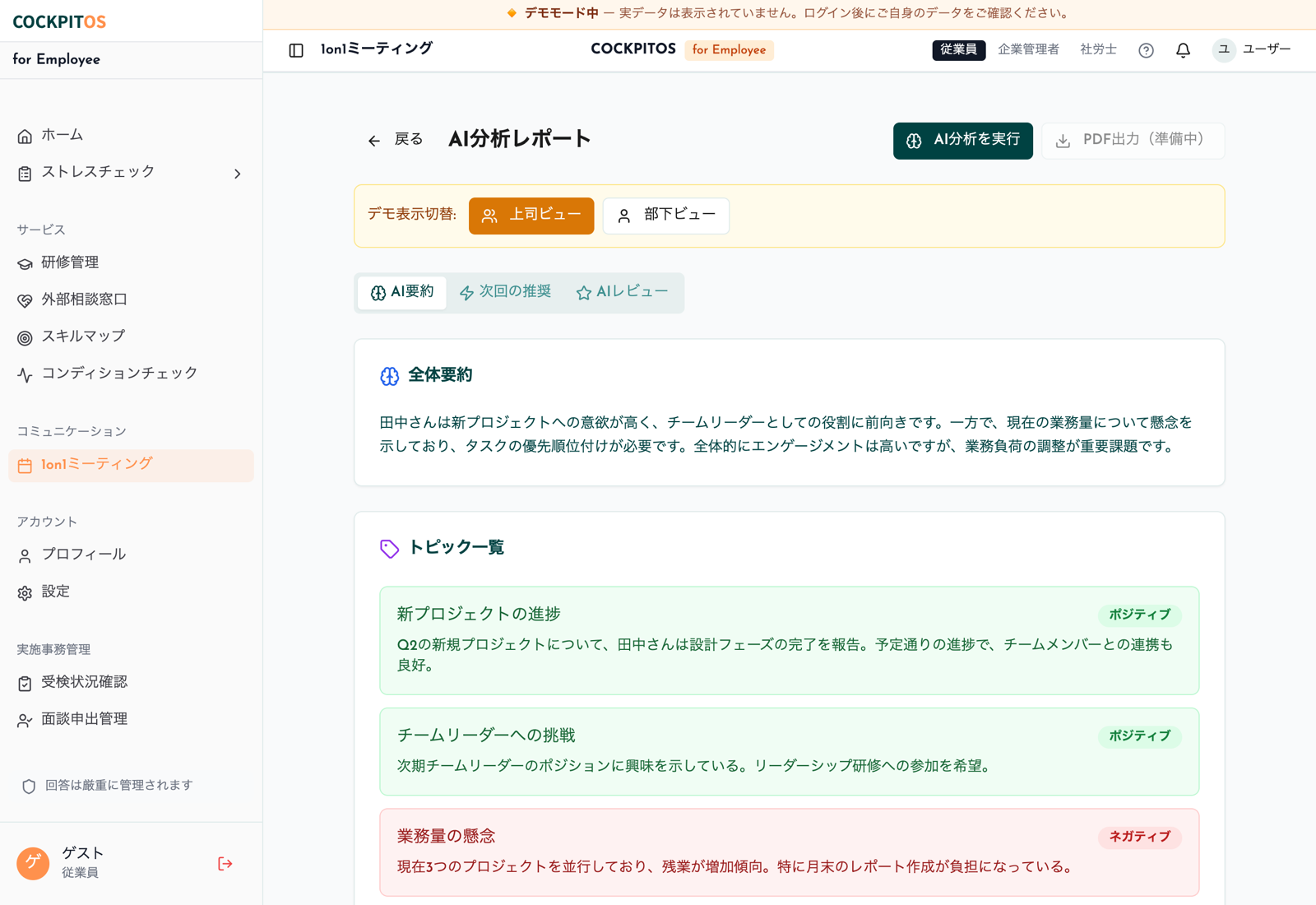
▲ COCKPITOS's 1on1 "AI Analysis Report": automatically organizes the conversation summary, per-topic sentiment (positive / negative), and suggested points for the manager (screen shows sample data in the demo environment).
1. Note-taking is what breaks consistency
A common reason 1on1s fizzle out is the burden of note-taking. Writing while listening is hard, and there's rarely time to write it up afterward — so records don't survive and last time's context is lost. Automatic transcription and AI summaries remove that burden directly.
2. How it works: transcribe, then summarize
In COCKPITOS, the conversation flows through two steps:
- Transcription (Amazon Transcribe): audio is turned into text automatically, in Japanese, with two-speaker diarization that separates speaker A from speaker B
- Summary/analysis (Amazon Bedrock / Claude): the text is distilled into key points, decisions, and next actions
The manager is freed from note-taking to focus on the conversation — and sometimes notices, in the transcript, a remark they glossed over live.
3. AI is a reflection tool, not a prediction engine
This is the point most easily misunderstood. The AI's role is to support summarizing and organizing the conversation — not to predict who will leave or to guarantee results.
- ✅ Can: organize key points, extract decisions and actions, aid reflection
- ❌ Won't/can't: assert turnover predictions, guarantee outcomes, join individual stress check results at the individual level (prohibited under Art. 66-10)
The conversation and the judgment stay with people.
4. Consent and privacy come first
To record, transcribe, and AI-process a 1on1:
- Obtain employee consent (never record without their knowledge)
- Communicate the purpose (less note-taking, better reflection)
- Keep records separate from evaluation
- Share internal rules for how records are handled
These practices make AI a tool people can trust. For distributed teams, this pairs with online 1on1s for distributed teams in Japan.
5. Turn summaries into the next conversation
A summary is worth little if it's filed and forgotten. Confirm the agreed actions in the next 1on1 and accumulate them per employee, so the AI summary feeds continuous dialogue rather than a one-off record.
Summary
Transcription (Amazon Transcribe) and summaries (Bedrock/Claude) cut the note-taking burden so managers can listen. But AI is a reflection tool, not a prediction engine — no guarantees, no turnover prediction, and no individual joining of stress check results. Used with consent and privacy first, AI summaries make 1on1s more consistent and more reflective.